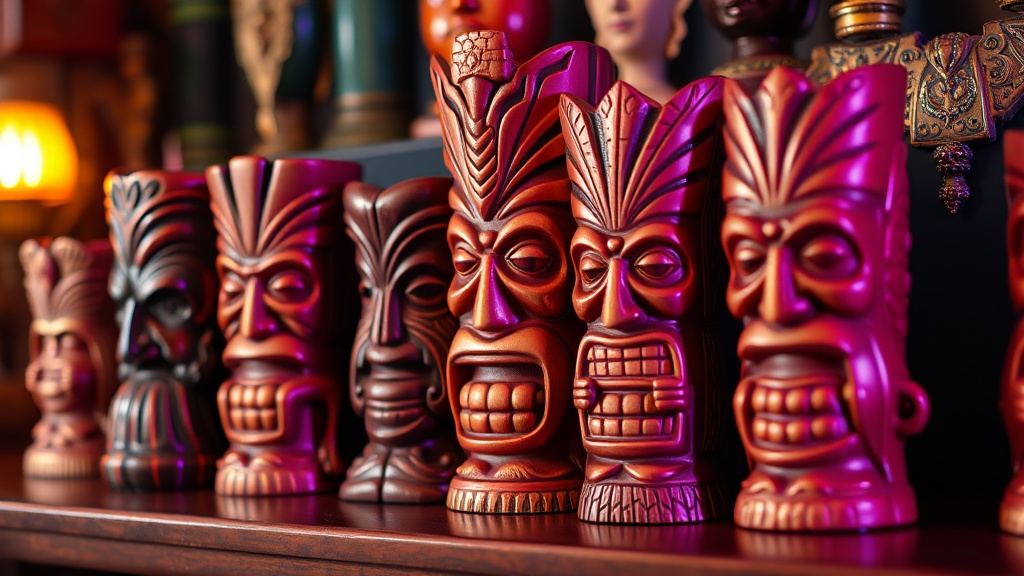
How to Display and Care for Your Vintage Tiki Mug Collection

What This Post Covers
This guide covers everything needed to display and preserve vintage tiki mugs—shelves, lighting, cleaning methods, climate control, and damage prevention. Whether the collection spans two shelves or an entire room, proper care keeps colors bright, glazes intact, and resale values steady. Tiki mugs are ceramic art pieces, often decades old, and they deserve more than a dusty corner cabinet.
How Should You Display a Vintage Tiki Mug Collection?
Open shelving with adjustable heights works best because tiki mugs vary wildly in size—from small Shag collaboration shot glasses to towering 24-ounce Munktiki sculptures. Floating shelves let you group mugs by era, artist, or bar of origin without hiding anything behind glass.
The IKEA LACK floating shelf is a budget-friendly staple in collector circles. Each 43-inch shelf holds about 15 to 20 standard mugs if spaced properly. For heavier pieces—like solid-cast Tiki Farm limited editions—mount shelves into wall studs. Drywall anchors won't cut it. (Trust that lesson.)
Glass-front cabinets offer dust protection but create two problems: glare from room lights and trapped humidity. If a cabinet is the only option, leave the doors slightly ajar—or install small vent holes in the back panel. LED strip lighting inside cabinets looks dramatic, but heat buildup matters. Stick to low-temperature Philips Hue Lightstrip Plus units mounted at the top, not the bottom, so heat rises away from the ceramics.
Here's the thing: direct sunlight is the silent killer. UV rays fade painted details and weaken glazes over time. North-facing walls are ideal. If that isn't an option, apply UV-blocking film to nearby windows. Museums do it. So should collectors.
What's the Best Way to Clean Old Tiki Mugs Without Damage?
Hand-wash only—never the dishwasher. The high heat and abrasive detergents in machines crack glazes, strip gold trim, and erode hand-painted details that make vintage mugs valuable.
Start with lukewarm water and a drop of mild dish soap. Dawn Ultra Original Scent is widely used because it cuts grease (often an issue with barware) without ammonia or bleach. Use a soft microfiber cloth or a natural sea sponge. Avoid scouring pads, stiff brushes, and abrasive powders like Comet.
For interior stains—coffee, rum residue, or decades of dust—try a baking soda paste. Mix three parts baking soda to one part water, swirl gently inside the mug, and let it sit for ten minutes. Rinse thoroughly. If a stain persists, don't force it. Some patina is part of the piece's history. (That said, mold is non-negotiable. If a mug smells musty, a diluted white vinegar rinse—one part vinegar to four parts water—will kill spores without harming the ceramic.)
Gold or metallic trim requires extra caution. These details are often applied over the glaze and can flake off with minimal provocation. Clean gold-rimmed mugs like 1960s Orchids of Hawaii imports with plain water and almost no pressure. Dry immediately with a lint-free towel to prevent water spots.
How Do Temperature and Humidity Affect Ceramic Collectibles?
Fluctuating temperature and humidity cause microscopic expansion and contraction in ceramic bodies and glazes, leading to hairline cracks—also called crazing—over time. Ideal conditions are stable: 65–72°F and 45–55% relative humidity.
Basements and attics are terrible choices. Basements trap moisture; attics swing from oven-hot to freezing. A climate-controlled living space—think a den, home bar, or dining room—is the safest home for vintage tiki ware. If the collection lives in a finished basement, run a dehumidifier. The Frigidaire 50-Pint Dehumidifier is a reliable workhorse for medium-sized rooms.
Worth noting: rapid temperature changes are worse than slightly high humidity. Never move a cold mug straight into a hot room, or vice versa. Ceramic doesn't flex. It cracks. This matters when unpacking shipped purchases in winter—let boxes acclimate for a few hours before opening.
Common Display Risks and How to Avoid Them
| Risk | Why It Happens | Prevention |
|---|---|---|
| Crazing (fine cracks in glaze) | Temperature swings, high humidity, age | Stable climate; avoid kitchens near ovens |
| Fading paint | UV exposure from windows or strong LEDs | UV-filtering film; indirect lighting only |
| Chipped bases or handles | Crowded shelves, earthquakes, pets, children | Non-slip shelf liner; 2-inch spacing minimum |
| Mineral deposits | Hard water left to dry inside mugs | Display empty; dry interiors after any rinse |
| Mold or musty odors | Stored while damp; poor air circulation | Clean thoroughly; display in open air |
How Do You Store Tiki Mugs That Aren't on Display?
Not every piece can sit on a shelf. Rotation keeps a collection fresh, and some mugs are simply too rare or fragile for daily exposure. For storage, acid-free tissue paper and sturdy plastic bins beat cardboard every time.
Wrap each mug individually in unbuffered acid-free tissue—not newspaper, which transfers ink and acid. Place the wrapped mug in a clear Sterilite 18-Quart Latch Box. These bins stack well, seal out dust, and let you see contents without unstacking everything. Add a packet of silica gel inside each bin to control moisture. Replace the silica every six months.
The catch? Never stack mugs inside one another. Ceramic-on-cceramic contact grinds away glaze and paint, especially at the rim. Even "nested" designs from the same manufacturer can chip each other during vibration or temperature shifts. One mug per bin compartment—or separate them with corrugated cardboard dividers.
Label every bin with the contents. A simple index card taped to the lid saves hours of hunting later. For high-value pieces—limited-run Tiki Diablo or early Tiki Bob's originals—consider photographing the mug with the storage bin number. Insurance companies appreciate documentation, and so will future buyers.
What About Lighting, Rotation, and "Using" the Collection?
There's an honest debate in tiki circles: are mugs meant to be used, or merely admired? The answer depends on the piece. A common 1970s Otagiri Mercantile Company volcano mug? Pour a Jet Pilot in it. A hand-numbered Thor mug from Tiki Oasis 2012? Probably best left dry.
If a mug gets used, rinse it within the hour. Sugary cocktails and citrus acids etch glaze over time. Don't let a Zombie sit overnight. For display-only pieces, rotate them every few months so the same side isn't facing the light source continuously. It's the same principle museums use for textiles and paintings—light damage is cumulative.
Track lighting can work if the bulbs are LED and positioned at least three feet from the shelves. Avoid halogen spots entirely. They run hot enough to warm a mug's surface, and heat plus dust equals accelerated glaze degradation. For home bars, under-cabinet LED strips from Lutron or Govee offer dimmable color options that don't throw much heat.
Are There Specific Products for Tiki Mug Care?
Yes—though most household items work fine, a few specialty products make the job easier.
Microfiber cloths: MagicFiber cleaning cloths (6-pack, about $9) are lint-free and gentle on painted surfaces.
Shelf liner: Duck Brand Smooth Top EasyLiner prevents sliding without adding texture that could scratch bases.
Display risers: BambooMN tiered stands, often sold for spice jars, work surprisingly well for smaller mugs. They create depth and keep pieces visible in deep cabinets.
Climate monitoring: A basic ThermoPro TP50 digital hygrometer ($12) tracks temperature and humidity on the shelf level—more accurate than guessing from a wall thermostat across the room.
For serious collectors, archival-quality storage supplies from Gaylord Archival offer museum-grade boxes, tissue, and acid-free boards. Overkill for a starter collection, perhaps—but worth the investment when individual mugs trade for hundreds of dollars.
How Do You Handle Repairs and Restoration?
Broken tiki mugs can sometimes be repaired, but restored pieces almost always lose value in the collector market. A clean break? Museum-quality conservation adhesive like Paraloid B-72 (applied by a professional) is reversible and won't yellow. Chips filled with epoxy and repainted? That's a hard pass for most serious buyers.
The rule of thumb: if the mug has monetary or historical significance, consult a ceramics conservator before attempting any repair. The American Institute for Conservation offers a find-a-conservator tool on their website. For common tourist-market mugs from the 1960s—a clean display with the damage visible is often more honest than a clumsy fix.
Here's the thing: every scratch, every fade, every crazed line tells a story. Tiki mugs were made for escape, for bars, for backyard luaus. Perfection isn't the goal. Preservation is. A well-cared-for collection—displayed with thought, cleaned with patience, and stored with respect—will outlast the collector and find its way into new hands, still bright, still strange, still carrying the spirit of tiki culture forward.